In pharmaceutical and life sciences organizations, quality rarely exists in isolation.
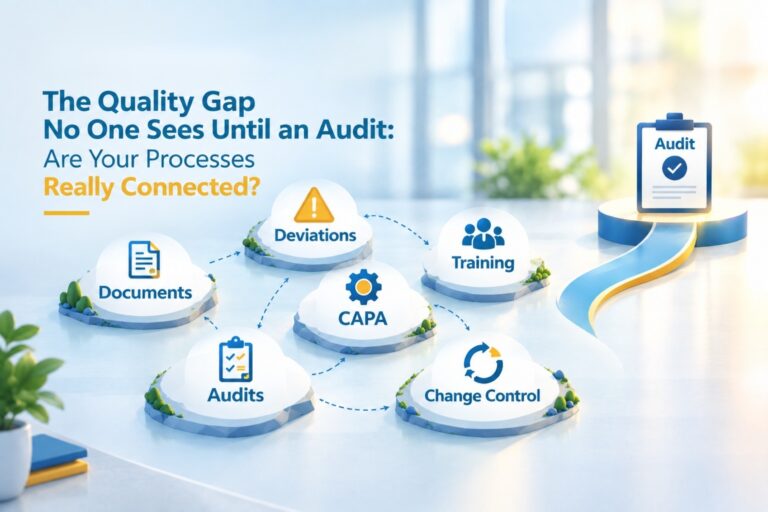
A deviation may lead to a CAPA. A CAPA may require a change. That change may affect an SOP. The revised SOP may require employee training. An audit finding may lead to corrective actions and additional evidence.
The processes are connected.
But in many organizations, the systems managing them are not.
Quality teams may still rely on a combination of:
- Spreadsheets
- Emails
- Shared folders
- Paper records
- Separate applications for different parts of the quality lifecycle
Each individual process may appear controlled, yet the connections between them can become difficult to track.
That is where a critical quality gap emerges: the organization has records, but not always a connected view of the quality story.
When Quality Data Exists but Quality Visibility Does Not
For regulated organizations, maintaining documented evidence is fundamental to GMP and quality management. Processes need to be defined, reviewed and documented, with records demonstrating that approved procedures are followed.
The challenge is not necessarily the absence of data. The challenge is finding the right data, connecting it and understanding what happened across multiple quality processes.
Example: Following a Change Control
A proposed change may be reviewed and approved correctly. But what happens next?
- Which documents are affected?
- Which departments need to act?
- Are related training requirements identified?
- Are associated quality records connected?
- Can the Quality team quickly demonstrate the complete history?
When these activities are managed across disconnected systems, employees often become the connection between them.
The Hidden Cost of Manual Connections
When people have to link quality processes by hand, it creates:
- Manual work and repeated follow-ups
- Duplicate data entry
- Opportunities for information to become fragmented
Why Disconnected Processes Create a Bigger Quality Problem
The consequences can extend beyond administrative inefficiency. Disconnected quality processes can make it harder to maintain:
- End-to-end traceability
- Document and record consistency
- Clear ownership and accountability
- Timely completion of quality activities
- Inspection readiness
- Reliable quality data for decision-making
Why It Shows Up During Audits and Inspections
The problem becomes particularly visible during audits and inspections.
An auditor may not simply want to see an individual record. They may need to understand the full picture surrounding a quality issue, including:
- The sequence of events
- Approvals and decisions
- Actions taken
- Supporting evidence
If that information is distributed across spreadsheets, email threads, folders and separate systems, retrieving the complete history can become a time-consuming exercise.
The question changes from “Do we have the record?” to:
“Can we demonstrate the complete story?”
What Should a Modern Quality System Do?
Moving away from disconnected processes does not simply mean replacing paper with software.
A modern electronic Quality Management System (eQMS) should create a controlled digital environment where related quality activities can be managed, tracked and connected. Organizations should look for the following capabilities.
1. Centralized Quality Records
Information should be accessible through a controlled system rather than scattered across multiple locations.
2. Workflow-Based Processes
Assignments, reviews, approvals, responsibilities and due dates should follow defined quality procedures.
3. Traceability
Related records should be connected so that teams can understand:
- What changed
- Why it changed
- Who approved it
- What actions followed
4. Controlled Documentation
Current and historical document versions should be managed within an appropriate document-control process.
5. Electronic Evidence
Approvals, audit trails and quality records should provide reliable evidence of activities performed within the system.
6. Connected Quality Processes
Deviations, CAPAs, change controls, audits, documents and training should not operate as unrelated islands.
The objective is not simply to digitize individual activities. It is to create a connected quality lifecycle.
Where Astakenis OneQMS Fits
This is the problem Astakenis OneQMS is designed to address.
OneQMS is a cloud-based eQMS platform built for regulated organizations, including:
- Pharmaceutical manufacturing
- Biotechnology
- CROs
- CDMOs
- Medical devices
It brings Quality Management, Document Management and Training Management together within one connected platform.
Quality Processes Managed in One Place
Instead of treating quality activities as separate applications or isolated records, OneQMS provides a connected environment for managing:
- CAPA
- Change Control
- Deviations
- Audits
- Complaints
- Incidents
- OOS/OOT
- Documents
- Training
When One Quality Activity Affects Another
This connectivity becomes particularly valuable when one quality activity affects another:
- A change can be managed through a controlled workflow.
- Related documents can be maintained with revision history and approvals.
- Training requirements can be assigned where applicable.
- Quality teams can maintain the associated records and traceability within the same digital environment.
The result is a more structured way to move through the quality lifecycle:
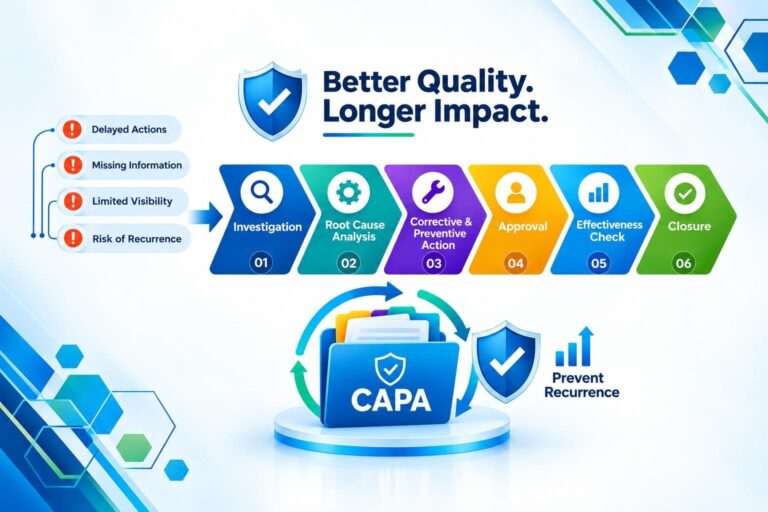
- Quality event
- Investigation
- Action
- Approval
- Implementation
- Evidence
From “Where Is That Record?” to “Here Is the Complete Quality Story”
Digital transformation in quality management should not be measured only by how many paper forms have been eliminated.
The more important question is whether quality teams can see, control and demonstrate how their processes work together. For pharmaceutical and life sciences organizations, that distinction matters.
A disconnected system can store information. A connected eQMS can help organizations connect the information, processes and evidence that make up the quality lifecycle.
With Astakenis OneQMS, the goal is not simply to digitize quality management. It is to create a more connected foundation for:
- Compliance
- Traceability
- Visibility
- Operational efficiency
- Inspection readiness
Because when the next audit question comes, having the record is only part of the answer.
Being able to demonstrate the complete quality story is what matters.