In pharmaceutical manufacturing, a quality issue is never just a single incident. A deviation, complaint, audit finding, OOS result or other quality event can require:
- Investigation
- Root cause analysis
- Corrective action
- Preventive action
- Approvals
- Effectiveness verification
The challenge begins when these activities are managed through paper forms, spreadsheets, emails and manual follow-ups.
For pharmaceutical companies operating under strict quality and regulatory expectations, the question is no longer simply “How do we close a CAPA?” but:
“How do we ensure the issue is properly investigated, corrected and prevented from happening again?”
Where Paper-Based CAPA Creates Challenges
Traditional CAPA management can create several practical problems for quality teams.
1. Difficult Record Tracking
Paper forms and physical files can make it difficult to quickly locate the complete history of a CAPA, especially when multiple departments are involved.
2. Manual Follow-Ups
Quality teams may spend significant time contacting action owners and checking whether corrective or preventive actions are completed on time.
3. Limited Visibility
With information spread across paper records, spreadsheets and emails, managers may not have a clear real-time view of:
- Open CAPAs
- Overdue CAPAs
- Pending CAPAs
4. Weak Traceability
When investigation records, approvals, actions and supporting information are maintained separately, establishing a complete history can become more difficult.
5. Difficulty Verifying Effectiveness
Completing an action does not necessarily mean that the problem has been resolved. The effectiveness of the implemented action must also be evaluated.
6. Increased Inspection Pressure
During an audit or regulatory inspection, quality teams need to demonstrate:
- What happened
- Why it happened
- What action was taken
- Who approved it
- Whether the action was effective
The FDA’s quality-system guidance specifically describes CAPA as involving investigation, understanding and correction of discrepancies, with the aim of preventing recurrence.
The Solution: A Structured Digital CAPA Process
A digital CAPA system can bring the complete process into a controlled workflow.
Instead of managing CAPA through disconnected documents and follow-ups, quality teams can manage the lifecycle through a structured process:
- Quality-event linkage for better traceability
- Root cause analysis to investigate underlying causes
- Corrective and preventive action management
- Configurable workflows for assignments, reviews, approvals and closure
- Task and due-date tracking
- Notifications and escalations
- Effectiveness verification
- Electronic approvals
- Audit trails for changes, actions, reviews and decisions
From Record-Keeping to Continuous Improvement
This approach provides greater visibility into:
- Responsibilities
- Timelines
- Actions
- CAPA status
More importantly, it shifts CAPA from being primarily a record-keeping activity to a structured continuous improvement process.
How Astakenis OneQMS Helps
Astakenis OneQMS CAPA provides a digital approach to managing the CAPA lifecycle.
Key CAPA Capabilities
- Quality-event linkage for better traceability
- Root cause analysis to investigate underlying causes
- Corrective and preventive action management
- Configurable workflows for assignments, reviews, approvals and closure
- Task and due-date tracking
- Notifications and escalations
- Effectiveness verification
- Electronic approvals
- Audit trails for changes, actions, reviews and decisions
The CAPA Lifecycle in OneQMS
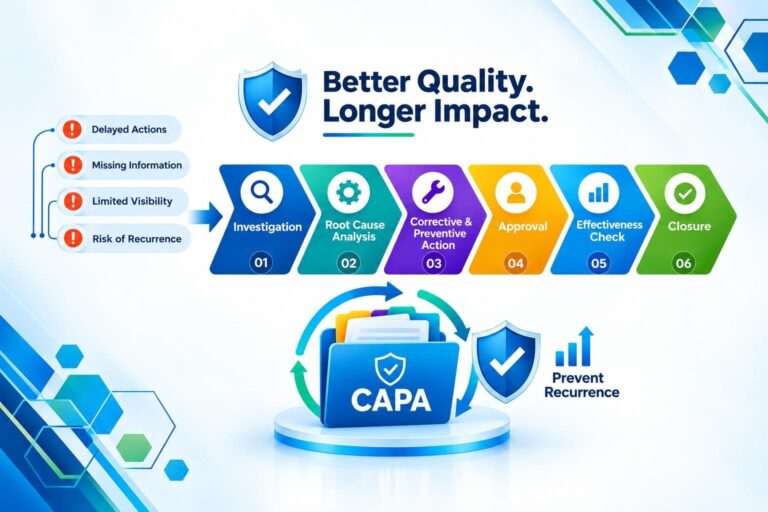
This gives pharmaceutical quality teams a structured way to manage CAPAs from start to finish:
- Initiation
- Investigation and root cause analysis
- Corrective and preventive actions
- Approval
- Effectiveness verification
- Closure
From CAPA Closure to Continuous Improvement
A CAPA should not be considered successful simply because it has been closed.
The real measure is whether the organization:
- Understood the root cause
- Implemented appropriate corrective and preventive actions
- Verified that those actions were effective
With a structured digital CAPA process, pharmaceutical organizations can improve visibility, accountability, traceability and quality oversight while creating a more consistent approach to managing recurring quality problems.
Make CAPA More Visible. More Traceable. More Controlled.
Astakenis OneQMS helps life sciences organizations digitize CAPA management and move beyond paper-based quality processes toward a more structured and connected quality environment.